
Interior design


UX Case study
Made By:
Marte Elida Hurum
Mia Fossum
Role: UX-Designer
Type: Case Study, Semester Assignment at Noroff, Summer 2023
Tools: Figma, Figjam, Google Form, Airtable
Date: April-June 2023
This case study, conducted in collaboration with Intiri, focuses on developing a well-functioning ecosystem that facilitates collaboration between interior designers, craftsmen, and private individuals seeking residential upgrades.
Background:
Norwegians are among the world’s leading home renovation enthusiasts, spending approximately NOK 94 billion on renovations each year. Despite this, only a small proportion hire interior designers. Intiri aims to make interior design services more accessible and affordable for homeowners.
Goal:
The project seeks to gain insights and explore new perspectives to inspire future development. It also aims to connect homeowners undertaking renovations with interior designers, while ensuring an intuitive and seamless user experience.
The design thinking process

Clients needs
Explore new ideas and solutions for their collaborative platform with these focus points:
Collaboration between end-customers and designers.
A social aspect for sharing and communicating personal/interior design and get feedback.
Interior design advisory and consultations from designers to end-customers.
Clients goals

Get insights and new ideas/angels to inspire future development.
Connect home owners who are renovating with interior designers.
Intuitive and good user experience.
Key findings from research
Average homeowner is women age 25-50.
Average cost using interior architect is 60.000 NOK.
Many people like doing things themselves to create an ownership and to save money.
Customers are most interested in colour palettes and furniture packages.
Competition pushes the price down.
More and more people appreciate sustainability.
What a client expects from interior designers:
Trustworthy
Affordable pricing
Easy communication
Previous work to look at
Quality products
Keeps up with time/trends
Good on practical/space-saving solutions
Take into account personal style and wishes

Opportunities for interior designers:
Partners
Package price
Stands
Marketing on Social media
Portfolio
Free revision
Follow market trends
Primary persona
Vision statement
Our platform guide users who need help with renovating by offering professional help and a quality home they love.
User need statement
Barista Bella needs easy access to inspiration, help finding her style and find smart solutions to her small apartment in order to get the most out of the space.

HMW
How might we help Bella furnish her apartment to get the most out of the space?
How might we help Bella stay within budget and prioritize the most important when renovating?
How might we help Bella create her dream home without too much time and effort?

Key findings from ideation

We did an ideation session with 6 participants. We used the Mission impossible and SCAMPER technique, and analysed the result by merging, dot-voting and then prioritizing the data in a MoScoW.
Information architecture

Style guide

Color palette
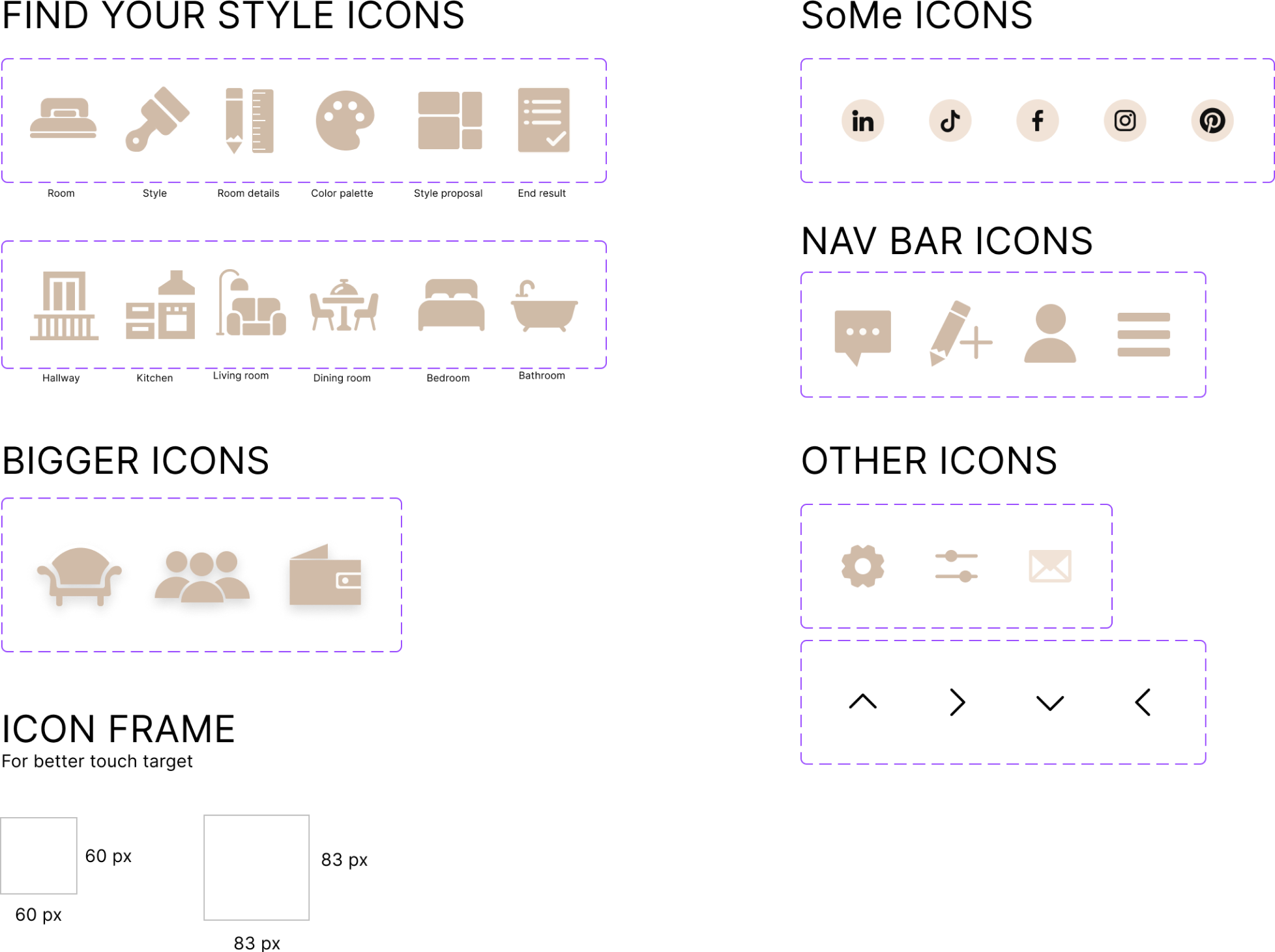
Iconography

Contrast
Font


User flow:
Usability test
Usability testing goals:
Gain insightful information about our prototypes functionality and usability
Identify usability problems
Improve the user experience
Validate our prototype
Usability testing tasks:
Make a new account and go through the onboarding.
Find your style through our quiz.
Book consultation with interior designer Siri Larsen.


Usability testing metrics:
Task completion %
Error
Time on task
Satisfaction rate 1-5
Feedback from usability test
“Find my style” btn more visible.
Make the arrow clickable or remove it.
Implement more inspiration in the app.
Change “Chat” in bottom nav bar with inspiration.
Make “create account” clearer.
Add time when booking consultation.
Explanation text
Make progress bars consistent


Iterations


Further recommendations
Research and testing:
Usability test on the new prototype (on the device it is designed for).
Test more flows, especially the new inspiration section.
Do more research on VR and AR, so we can work on implementing that into our platforms.
Design and features:
See if we can make the onboarding more engaging.
Implement AR.
Keep designing the website so it matches the app.
Keep working on designing the inspiration pages. (This needs a lot of testing and work to be as good as we wish for)

The design on different devices


Prototype
